
PROBIO Journal · Micronutrients
Which magnesium is best? Forms of magnesium compared
Citrate, bisglycinate, malate or oxide: which form of magnesium suits you?
Not all magnesium is the same. The label always says “magnesium”, but what matters is the compound. In this guide we compare the most important forms of magnesium, explain what magnesium does, how much magnesium each compound contains and what to look for when buying.
What magnesium does: why does the body need magnesium?
Magnesium is an essential mineral. An adult’s body contains about 25 g of magnesium, a good half of it in the bones and the rest mainly in muscles and organs. Magnesium is involved in more than 300 enzyme reactions. The following applies to magnesium:
- Magnesium contributes to normal muscle function.
- Magnesium contributes to the normal functioning of the nervous system.
- Magnesium contributes to normal energy-yielding metabolism.
- Magnesium contributes to the reduction of tiredness and fatigue.
- Magnesium contributes to electrolyte balance and to normal psychological function.
- Magnesium contributes to the maintenance of normal bones and teeth.
Forms of magnesium: organic and inorganic
In food supplements, magnesium always occurs as a compound. Broadly speaking, there are two groups:
Organic magnesium compounds
Here, magnesium is bound to an organic acid or amino acid, for example to citric acid (magnesium citrate), glycine (magnesium bisglycinate), malic acid (magnesium malate), lactic acid (magnesium lactate) or gluconic acid (magnesium gluconate). Organic forms of magnesium are readily water-soluble and are considered readily available.
Inorganic magnesium compounds
These include magnesium oxide, magnesium carbonate and magnesium phosphate. They contain a lot of magnesium per gram, but magnesium oxide is poorly water-soluble. That is why studies consider magnesium oxide less readily available than organic forms.
Magnesium forms compared
| Form of magnesium | Magnesium content (approx.) | Typical |
|---|---|---|
| Magnesium citrate | 11 to 16 % | a classic, readily soluble, mildly laxative in larger amounts |
| Magnesium bisglycinate | 14 % | bound to glycine (chelate), considered particularly gentle on the stomach |
| Magnesium malate | 15 % | bound to malic acid, often taken during the day |
| Magnesium orthophosphate | 20 to 27 % | high magnesium content, neutral taste |
| Magnesium lactate | 12 % | bound to lactic acid, well tolerated |
| Magnesium gluconate | 6 % | mild form, low magnesium content |
| Magnesium oxide | 60 % | inexpensive and highly concentrated, but poorly soluble |
| Magnesium L-threonate | 8 % | new form, expensive, low magnesium content |
The magnesium content shows how much elemental magnesium the compound contains. To find out how to convert the information on the pack correctly, read the article Magnesium dosage.
Magnesium citrate, bisglycinate or malate: which is better?
Magnesium citrate
Magnesium citrate is the best-known organic form of magnesium. It dissolves well in water and is often available as a powder or capsule. In larger single amounts, magnesium citrate can have a laxative effect. That is why splitting it into two servings makes sense.
Magnesium bisglycinate
In magnesium bisglycinate (also magnesium glycinate), magnesium is bound to two molecules of the amino acid glycine. This chelate form is considered particularly gentle on the stomach and is often chosen when other forms upset the gut.
Magnesium malate
Magnesium malate is bound to malic acid, which plays a role in the energy metabolism of cells. That is why many people prefer to take magnesium malate during the day.
Conclusion: Which magnesium is best? There is no single best form of magnesium. Citrate, bisglycinate and malate are all readily available organic forms. What matters is your tolerability, the amount of elemental magnesium and regular intake.
Which magnesium to buy? Why combine several forms of magnesium
Instead of trying out a single form of magnesium, many people opt for a magnesium complex with several compounds. The advantage: you do not have to test citrate first, then bisglycinate, then malate. A combination unites the properties of different forms in one capsule, and the total amount is spread across several compounds.
There are hardly any studies that compare one specific complex with a single form. A complex is therefore above all a question of tolerability, breadth and convenience.
MULTI MAGNESIUM 7 combines seven magnesium salts: malate, orthophosphate, citrate, bisglycinate, gluconate, lactate and L-ascorbate.
Magnesium deficiency: symptoms and risk groups
Commonly cited signs of magnesium deficiency are muscle twitching, calf cramps, tiredness, nervousness or palpitations. These symptoms are non-specific and can have many causes. A magnesium deficiency can only be determined by a doctor with a blood test. Please have persistent symptoms checked by a doctor.
The following should pay particular attention to their magnesium intake: people who do a lot of sport and sweat heavily, pregnant and breastfeeding women, older people, people who drink alcohol regularly and people who take certain medicines such as diuretics or acid blockers.
Taking magnesium correctly
- How much? For adults, the DGE gives 300 mg (women) and 350 mg (men) of magnesium per day. From food supplements, the BfR recommends no more than 250 mg. More in the article Magnesium dosage.
- When? With a meal, ideally split between morning and evening. More in the article Magnesium in the morning or evening?
- Diarrhoea from magnesium? The single serving is usually too large. Split the amount or choose a form that is gentle on the stomach, such as bisglycinate.
- Medicines: Keep a gap of 2 to 4 hours from antibiotics, thyroid hormones and osteoporosis medicines. If you have kidney disease, only after consulting your doctor.
From the PROBIO range
MULTI MAGNESIUM 7: seven magnesium salts in one formula
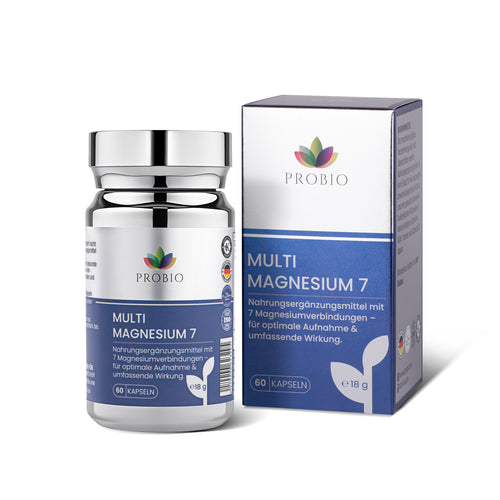
MULTI MAGNESIUM 7 brings together seven organic and inorganic magnesium compounds. 2 capsules provide 251 mg magnesium (67 % NRV).
| Form of magnesium | Magnesium per 2 capsules |
|---|---|
| Magnesium malate | 70 mg |
| Magnesium orthophosphate | 70 mg |
| Magnesium citrate | 50 mg |
| Magnesium bisglycinate | 48 mg |
| Magnesium gluconate | 5.3 mg |
| Magnesium lactate | 4.6 mg |
| Magnesium L-ascorbate | 3.1 mg |
- Magnesium contributes to normal muscle function and to the normal functioning of the nervous system.
- Magnesium contributes to the reduction of tiredness and fatigue.
- 2 capsules daily with meals, 60 capsules last 30 days
Frequently asked questions
Which magnesium is best?
There is no single best form of magnesium. Organic forms such as magnesium citrate, magnesium bisglycinate and magnesium malate are considered readily available. What matters is tolerability, the amount of elemental magnesium and regular intake.
What is the difference between magnesium citrate and magnesium bisglycinate?
Magnesium citrate is bound to citric acid, readily soluble and mildly laxative in larger amounts. Magnesium bisglycinate is bound to the amino acid glycine and is considered particularly gentle on the stomach.
What is magnesium malate good for?
Magnesium malate is an organic form of magnesium, bound to malic acid. Like all magnesium, it contributes to normal energy-yielding metabolism and to the reduction of tiredness and fatigue. Many people take it during the day.
Is magnesium oxide bad?
Magnesium oxide contains a lot of magnesium, but is poorly water-soluble and is considered less readily available than organic forms. It is inexpensive and is therefore found in many chemist’s products.
Why combine several forms of magnesium?
A combination unites the properties of different forms in one capsule. You do not have to test several individual products, and the total amount is spread across several compounds.
Can magnesium cause diarrhoea?
Yes, especially with large single servings. Divide the daily amount into two servings and take magnesium with a meal.
Which magnesium for calf cramps?
Magnesium contributes to normal muscle function. If you have frequent calf cramps, however, you should have the cause checked by a doctor, because cramps can have many causes.
Which forms of magnesium does MULTI MAGNESIUM 7 contain?
Seven: malate, orthophosphate, citrate, bisglycinate, gluconate, lactate and L-ascorbate. Together, 2 capsules provide 251 mg magnesium.
What distinguishes a magnesium complex from simple magnesium tablets?
Simple tablets often rely on a single, inexpensive compound. A complex combines several salts, some of whose raw materials are more expensive. Compare the compound, pure magnesium per day and the ingredient list.
What does bioavailability mean?
Bioavailability describes what proportion of a nutrient is absorbed and available to the body. Among other things, it depends on the compound, the amount, the meal and the person. Higher bioavailability alone says nothing about a health benefit.
Read more in the PROBIO Journal
- Magnesium dosage: how much magnesium per day makes sense?
- Magnesium before or after eating? Morning or evening?
- Zinc: efficacy, dosage and how to take it correctly
- Quality at PROBIO: raw materials, forms and bioavailability
This article is for general information only and does not replace medical advice, diagnosis or treatment. Food supplements should not be used as a substitute for a varied and balanced diet and a healthy lifestyle.