
PROBIO Journal · Micronutrients
Magnesium dosage: how much magnesium per day makes sense?
Daily requirement, maximum amount and how to calculate correctly: how to find the right magnesium dosage.
How much magnesium do you need per day, how much magnesium from food supplements makes sense and when is it too much? In this guide you will learn everything about magnesium dosage: the daily magnesium requirement by age, the recommendation of the German Federal Institute for Risk Assessment (BfR), how to read the information on the pack correctly and how best to dose magnesium in everyday life.
Daily magnesium requirement: how much magnesium per day?
Magnesium is a mineral that the body cannot produce itself. It has to be obtained from food every day. The German Nutrition Society (DGE) gives these estimated values for an adequate magnesium intake:
| Age | Women | Men |
|---|---|---|
| Adults aged 19 and over | 300 mg | 350 mg |
| Pregnant women | 300 mg | – |
| Breastfeeding women | 300 mg | – |
The reference value on food supplement labels (NRV) is 375 mg magnesium per day. With a balanced diet, a large part of this already comes from food.
Magnesium dosage from food supplements: how much makes sense?
The German Federal Institute for Risk Assessment (BfR) recommends taking no more than 250 mg magnesium per day in addition from food supplements, ideally divided into at least two servings. The rest comes from your diet. Larger single amounts can have a laxative effect. For magnesium dosage, therefore: two smaller servings are better than one large one.
A high-dose magnesium tablet with 400 mg or more is therefore usually not necessary for daily supplementation. For most adults, a magnesium dosage of around 250 mg from food supplements, split between morning and evening, is suitable.
Dosing magnesium correctly: how to calculate
Many packs state the amount of the magnesium compound, for example “500 mg magnesium citrate”. What matters for magnesium dosage, however, is the elemental magnesium it contains, and that is considerably less. Magnesium citrate, for example, contains only around 15 % magnesium.
- In the nutrition table, look for the line “Magnesium” in mg.
- The percentage (% NRV) shows how much of the reference value of 375 mg is covered.
- Add up the magnesium from all products, including multivitamins, sports drinks or mineral water high in magnesium.
To find out which form of magnesium suits you, whether citrate, bisglycinate, malate or oxide, read our comparison of magnesium forms.
Magnesium dosage with increased requirements
- Sport and heavy sweating: Magnesium is lost through sweat. Magnesium contributes to normal muscle function and to electrolyte balance.
- Stressful periods and little time to eat: Wholegrains, nuts and vegetables then often fall short.
- Pregnancy and breastfeeding: The requirement is slightly increased. Please discuss supplementation with your doctor.
- Older people: They often eat less and absorb magnesium less well.
- Regular alcohol: Alcohol increases the excretion of magnesium.
- Certain medicines: Such as diuretics or acid blockers. Ask your pharmacist about the right interval.
If you have frequent calf cramps, palpitations or persistent tiredness, please have the cause checked by a doctor. A magnesium deficiency can only be determined by a blood test.
Too much magnesium: what happens with an overdose?
If your kidneys are healthy, the body excretes excess magnesium. An overdose of magnesium from normal foods is hardly possible. The typical sign of too large a single serving from food supplements is soft stools or diarrhoea. In that case, split the daily amount or reduce it.
The right magnesium dosage is therefore above all a question of tolerability. If you have kidney disease, please take magnesium only after consulting your doctor.
Magnesium dosage in everyday life: 5 simple rules
- Split: Divide the daily amount into two servings, for example at breakfast and dinner.
- With a meal: This is how most people tolerate magnesium best.
- Check the total amount: Do not combine several magnesium products without adding them up.
- Regularly: At the same time every day, as a fixed routine.
- Keep a gap: About 2 hours from certain medicines such as antibiotics or thyroid hormones.
Whether you should take magnesium in the morning or evening, before or after eating, is explained in detail in the article Magnesium before or after eating? Morning or evening?
Magnesium in the morning or evening, before or after eating?
For most people, taking it with a meal or straight afterwards is the most comfortable. On an empty stomach, magnesium can cause stomach rumbling or soft stools in sensitive people. Together with food it is usually better tolerated, and absorption remains good.
If you tolerate magnesium well on an empty stomach, however, there is nothing against it. What matters is that it is comfortable for you and that you take it regularly.
Both are possible. Choose the time at which you can most reliably build it into your day:
Magnesium in food: covering your daily requirement through diet
| Food | Magnesium per 100 g (approx.) |
|---|---|
| Pumpkin seeds | 400 to 500 mg |
| Sunflower seeds | 400 mg |
| Cashew nuts | 270 mg |
| Rolled oats | 130 mg |
| Dark chocolate (70 %) | 150 to 200 mg |
| Wholegrain bread | 60 to 90 mg |
| Spinach | 60 to 80 mg |
| Banana | 30 mg |
Guide values; these vary depending on variety and source.
From the PROBIO range
MULTI MAGNESIUM 7: 251 mg magnesium from 7 magnesium salts
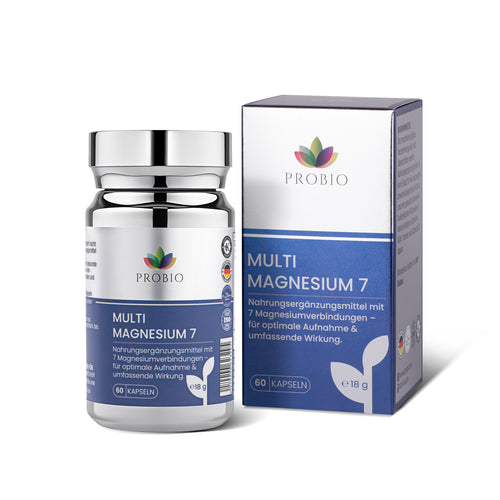
MULTI MAGNESIUM 7 provides 251 mg magnesium (67 % NRV) with 2 capsules. This corresponds to the BfR guidance of around 250 mg per day from food supplements. Our tip: 1 capsule with breakfast, 1 capsule with dinner.
What it includes: Seven individually named magnesium salts, no magnesium oxide and no other excipients apart from the capsule shell.
| Magnesium compound | Magnesium per 2 capsules |
|---|---|
| Magnesium malate | 70 mg |
| Magnesium orthophosphate | 70 mg |
| Magnesium citrate | 50 mg |
| Magnesium bisglycinate | 48 mg |
| Magnesium gluconate | 5.3 mg |
| Magnesium lactate | 4.6 mg |
| Magnesium L-ascorbate | 3.1 mg |
| Total | 251 mg (67 % NRV) |
- Magnesium contributes to normal muscle function and to the normal functioning of the nervous system.
- Magnesium contributes to normal energy-yielding metabolism and to the reduction of tiredness and fatigue.
- 2 capsules daily with a meal, 60 capsules last 30 days
Frequently asked questions about magnesium dosage
How much magnesium does an adult need per day?
According to the DGE, 300 mg for women and 350 mg for men aged 19 and over. A large part of this comes from the diet.
How much magnesium from food supplements makes sense?
The BfR recommends no more than 250 mg magnesium per day from food supplements, divided into at least two servings.
Is 400 mg magnesium a day too much?
As a total intake from food and food supplements, this is not unusual. From food supplements alone, it is above the BfR recommendation of 250 mg and can have a laxative effect.
What happens if you take too much magnesium?
If your kidneys are healthy, excess magnesium is excreted. Soft stools or diarrhoea are typical of too large a single serving. If you have kidney disease, please take it only after consulting your doctor.
Should you split magnesium between morning and evening?
Yes, that makes sense. Two smaller servings are usually better tolerated than one large one, for example with breakfast and with dinner.
How much magnesium for sport?
If you sweat a lot, you lose some magnesium. Focus first on magnesium-rich foods and supplement within the BfR recommendation of up to 250 mg per day.
Which magnesium dosage makes sense for women?
For women aged 19 and over, the DGE gives 300 mg magnesium per day, including during pregnancy and breastfeeding. From food supplements, the BfR recommends no more than 250 mg per day.
How long can you take magnesium?
In the recommended amount, long-term use is possible.
How much magnesium does MULTI MAGNESIUM 7 contain?
2 capsules provide 251 mg magnesium from 7 magnesium salts, which is 67 % of the reference value. A tub of 60 capsules lasts 30 days.
Is magnesium better before or after eating?
With or after a meal is easier to tolerate for most people. On an empty stomach is possible if you tolerate it well.
Should you take magnesium in the morning or evening?
Both are possible. Choose the time you can stick to most reliably. With two capsules per day, splitting them between morning and evening is ideal.
Read more in the PROBIO Journal
- Magnesium before or after eating? Morning or evening?
- Magnesium forms compared: citrate, bisglycinate, malate
- Zinc: efficacy, dosage and how to take it correctly
- Quality at PROBIO: raw materials, forms and bioavailability
This article is for general information only and does not replace medical advice, diagnosis or treatment. Food supplements should not be used as a substitute for a varied and balanced diet and a healthy lifestyle.